
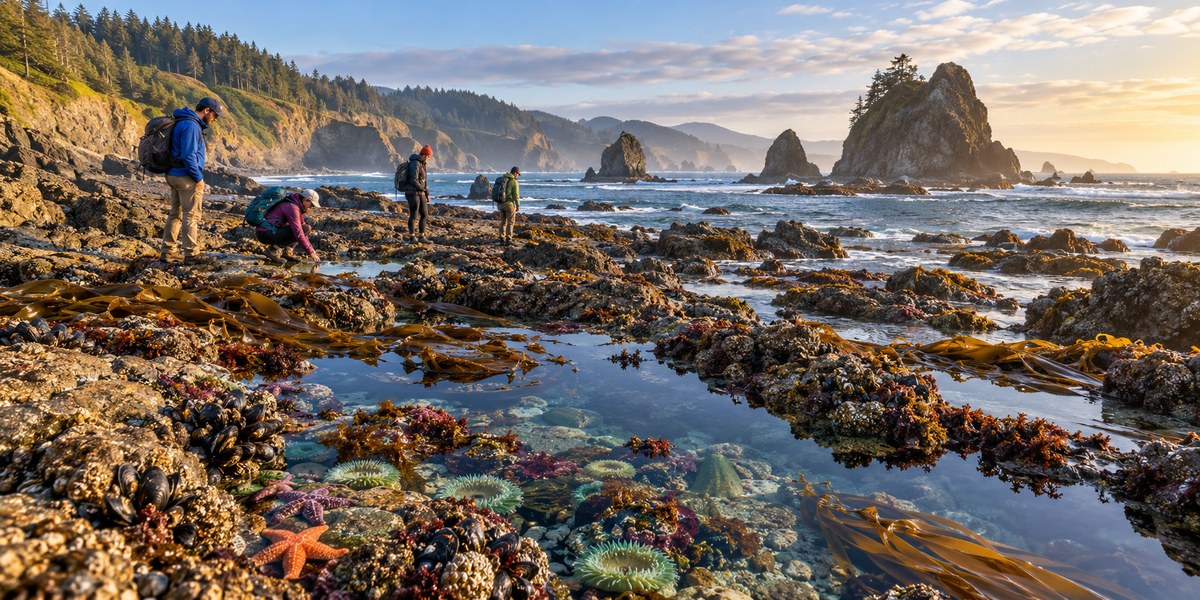
The Pacific Coast hides a living museum under the waves. Twice a day, the ocean pulls back and reveals a secret world of starfish, anemones, and scuttling crabs. For families and outdoor enthusiasts, low tide is the golden hour. The trails that lead to these pools are short, scenic, and packed with discovery. But timing is everything. Show up at the wrong hour and the tide will be lapping at your ankles. Show up at the right one and you will step into a natural aquarium.
The best tidepool hikes on the Pacific Coast combine easy walking trails with low tide windows below +1.5 feet. Timing your visit to a negative tide is critical for seeing the most marine life. Always check a local tide chart before you go, wear grippy shoes on wet rock, and never turn your back on the ocean.
How to Read a Tide Chart for Tidepool Hikes
Before you lace up your boots, you need to understand the numbers. Tide charts tell you two things: the height of the water and the time of low tide. For tidepooling, you want a low tide of 0.0 feet or lower. Negative tides (like -0.5 or -1.0 feet) are even better. They expose the deeper pools that hold octopus, urchins, and giant green anemones.
Here is a simple process to plan your trip:
- Look up the tide chart for your chosen beach on a site like NOAA or a dedicated tide app.
- Find the date you want to hike. Note the time of the lowest tide.
- Subtract one hour from that time. That is when the water will start to pull back far enough to reveal the best pools.
- Add two hours to the low tide time. That is when the water will start returning.
- Aim to arrive at the trailhead at least 30 minutes before the low tide window opens.
This gives you a solid three hour window to explore safely.
What to Bring for a Low Tide Adventure
Tidepool hiking is not the same as a mountain trek. The terrain is wet, slippery, and often sharp. Packing the right gear makes the difference between a great day and a frustrating one.
- Footwear: Water shoes with a stiff sole or old sneakers with good grip. Do not wear flip-flops. Barnacles cut like glass.
- Layers: Coastal fog can roll in fast. A windbreaker or fleece is your friend.
- Sun protection: The sun reflects off the water. Bring sunscreen and a hat.
- A camera or phone: You will want to document the purple stars and orange sea cucumbers.
- A small towel: For drying off sandy feet before the drive home.
For more general advice on what to carry on longer trails, check out our guide on essential outdoor gear every hiker should pack for long trails. The principles apply even on short coastal walks.
Common Mistakes and How to Avoid Them
Even experienced hikers make errors when tidepooling. The table below breaks down the most frequent mistakes and the simple fixes.
| Mistake | Why It Happens | How to Fix It |
|---|---|---|
| Getting trapped by incoming tide | Not watching the time or the waves | Set a phone alarm for 30 minutes before the tide turns. Always know your exit route. |
| Touching or stepping on animals | Curiosity or poor footing | Look with your eyes, not your hands. Step only on bare rock or sand. |
| Wearing the wrong shoes | Underestimating the slickness of wet rock | Use shoes with rubber soles designed for wet surfaces. Test your grip before walking far. |
| Missing the best pools | Arriving too late or too early | Arrive one hour before the lowest tide. The pools at the lowest edge are the richest. |
| Forgetting the tide chart | Relying on memory or guesswork | Save a screenshot of the tide chart on your phone before you leave home. |
Expert advice from a California state park ranger: “The most important rule is to never turn your back on the ocean. A sneaker wave can arrive without warning. Keep your eyes on the water, especially if you hear a change in the wave pattern. If the tide is rising, head for high ground immediately.”
7 Tidepool Hikes Along the Pacific Coast You Can Do at Low Tide
These trails are spread from Northern California down to Southern California. Each one offers a unique coastal experience. All of them are best done during a low tide of +1.0 feet or lower.
1. Natural Bridges State Beach (Santa Cruz, CA)
This beach is famous for its monarch butterflies and its massive sandstone bridge. But the tidepools here are some of the best in Northern California. The trail from the parking lot to the beach is short and paved. At low tide, you will find large pools filled with sea stars, hermit crabs, and mossy chitons. The park hosts guided tidepool walks on weekends during the winter months.
2. Point Lobos State Natural Reserve (Carmel, CA)
Point Lobos is a crown jewel of the California coast. The trails here wind through cypress groves and along granite cliffs. The best tidepooling is at Weston Beach and Whalers Cove. The rocks are layered and create deep, sheltered pools. Look for purple sea urchins and the occasional octopus hiding under a ledge. The trail is about 1.5 miles round trip if you walk from the main parking area.
3. Leo Carrillo State Park (Malibu, CA)
This park has a long stretch of beach with rocky reefs that extend far out at low tide. The trail from the day-use lot drops down to the sand. Head north toward the point. The pools here are full of small fish, crabs, and aggregating anemones. It is a great spot for families because the beach is wide and the water recedes a long way.
4. Fitzgerald Marine Reserve (Moss Beach, CA)
This is a protected marine reserve, which means no collecting is allowed. That also means the wildlife is abundant and less shy. The trail is a short walk from the parking lot to the rocky shelf. At a minus tide, you can walk out onto a flat bench of rock covered in pools. Harbor seals sometimes haul out on the nearby sandbar. Check the reserve’s website for volunteer docent led tours.
5. Shell Beach (Jenner, CA)
Located in Sonoma County, Shell Beach is part of the Sonoma Coast State Park. The trail is a half-mile downhill walk through coastal scrub. At the bottom, a series of rocky outcroppings create dozens of small pools. This spot is less crowded than the beaches farther south. The water is cold and clear, making it easy to spot sea stars and anemones.
6. Abalone Cove Shoreline Park (Rancho Palos Verdes, CA)
This park offers one of the most dramatic tidepooling experiences in Southern California. The trail descends from the bluff to a rocky cove. At low tide, you can walk out to the reef and see large pools with giant green anemones, sea hares, and bat stars. The park is part of the Palos Verdes Nature Preserve, so the habitat is well protected.
7. Duxbury Reef (Bolinas, CA)
Duxbury Reef is the largest shale reef in California. At low tide, it becomes a massive plateau of tidepools. The trail starts at the end of Olema Avenue in Bolinas and leads down to the beach. The reef extends far out, so you can walk a quarter mile from shore. This is a prime spot for seeing nudibranchs and small octopus. Go during a minus tide for the best results.
For more inspiration on where to walk, take a look at our list of why these 6 coastal hiking trails belong on your bucket list. These trails pair perfectly with a tidepool excursion.
Safety Rules for Tidepool Hiking
The ocean is powerful. Even on a calm day, a wave can sweep you off your feet. Follow these rules every time.
- Check the tide chart before you leave home and again when you arrive.
- Tell someone where you are going and when you plan to return.
- Wear shoes with grip. Wet rock is as slick as ice.
- Keep children within arm’s reach at all times.
- Do not touch or disturb the animals. They are fragile and protected by law.
- Watch the horizon for larger waves. If you see one coming, move to higher ground.
- Leave the beach before the tide turns. The water comes in faster than most people expect.
If you want to build your confidence on the trail, our guide on top tips for planning a safe and enjoyable trail hike covers navigation, weather awareness, and emergency planning in more detail.
How to Teach Kids to Explore Tidepools Respectfully
Children are naturally drawn to tidepools. The bright colors and moving creatures are irresistible. Use these moments to teach respect for the ocean.
- Show them how to walk slowly and look before stepping.
- Explain that the animals are alive and need to stay in their homes.
- Let them touch a smooth rock or a piece of seaweed, but never the animals.
- Play a game of “I Spy” to spot different colors or shapes.
- Bring a guidebook or use a phone app to identify species together.
A good rule of thumb is to leave the pool exactly as you found it. Turn over rocks gently and place them back in the same position. Many creatures live under the rocks for protection from the sun and waves.
When to Go for the Best Tidepooling in 2026
Tide charts vary by location, but there are patterns. The best low tides for tidepooling happen during the new moon and full moon phases. In 2026, some of the lowest tides will occur in the late spring and early summer months. May and June often produce negative tides in the early morning hours. Fall months can also bring excellent low tides in the late afternoon.
Here is a list of tips for picking your date:
- Check the tide chart at least one week ahead of your planned hike.
- Look for tides below 0.0 feet. Negative tides are ideal.
- Choose a day with calm weather. Wind creates waves that make pools murky.
- Go early in the morning or late in the afternoon to avoid crowds.
- Avoid weekends if you want solitude. Weekday mornings are quietest.
For families, we recommend 7 family-friendly hiking trails that kids will love. Many of these trails are near the coast and can be paired with a tidepool visit.
Your Next Low Tide Adventure Starts Here
The Pacific Coast is a long ribbon of wild shoreline. Every beach has its own character. Some offer sandy walks. Others offer rocky scrambles. But the tidepools are the hidden treasure. They change with every season and every tide. A pool you visit in March will look different in October. The animals move, grow, and shift with the currents.
Start with one of the seven hikes listed above. Pick a date with a good low tide. Pack your bag, grab your family or a friend, and head to the coast. The trail will lead you to a world that most people never see. All you need is the right time, the right shoes, and a sense of wonder.
If you are new to coastal hiking, our article on best hiking trails for beginners: start your outdoor adventure today will help you find the right starting point. Many of the trails on that list are flat, short, and perfect for a low tide outing.
The ocean is waiting. Go find your pool.




Leave a Reply